
- in Production by Bobby Owsinski
New Music Gear Monday: Slate Digital Rotary SD-147 Plugin
I’m an old Hammond organ player from way back, starting with L-100’s and M-3s, then working myself up to a B-3. Along the way I owned a variety of Leslie rotating speakers, including models 45, 145, 147, and 122.
The point is that I have lots of hands-on experience with rotating speakers, which means I’m always anxious to try a new modeling plugin when it’s released to see how close it gets to the real thing. The new Rotary SD-147 from Slate Digital puts the full behavior of a real Leslie right inside your DAW, and adds a few tricks that the original hardware could never pull off.
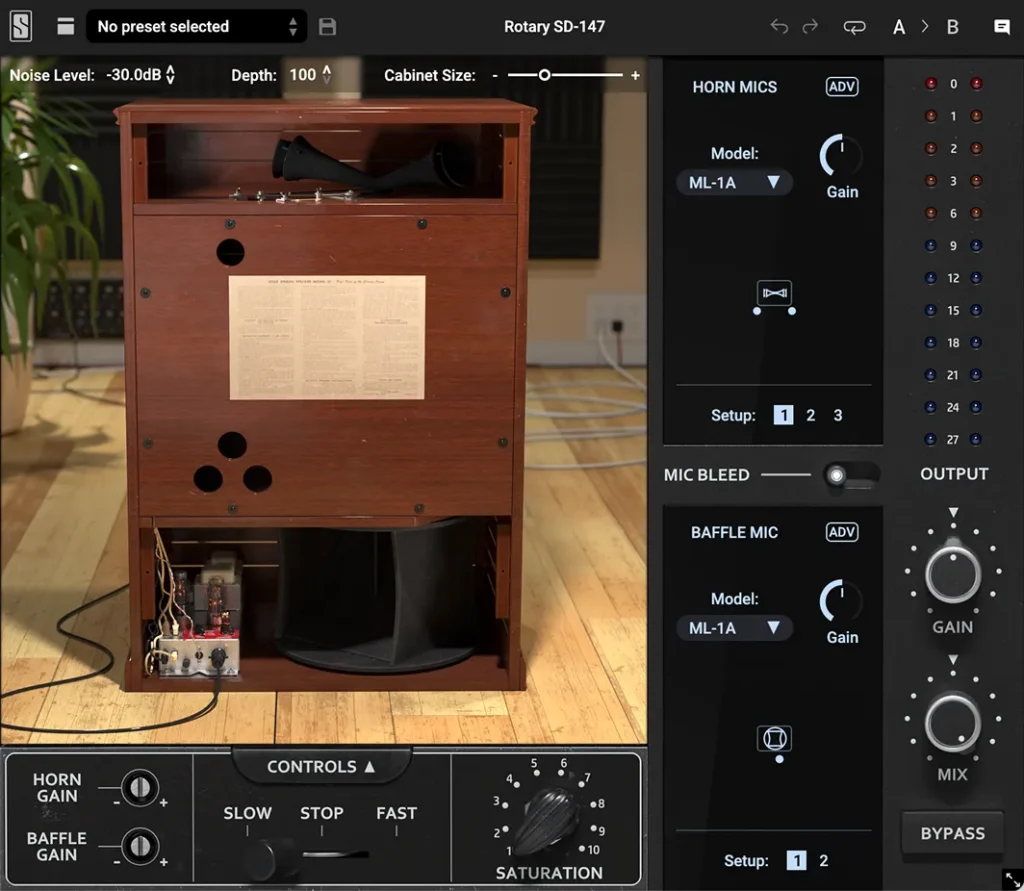
Two Rotors, Fully Modeled
Many don’t realize that the rotating speaker cabinet has been part of recorded music for over 60 years, and for good reason. Whether it was the classic electric organ on a jazz or gospel track, the psychedelic swirl on guitar, or the dreamy shimmer on vocals, that spinning sound gave producers a texture that nothing else could touch.
The problem has always been the same though: those original cabinets are massive (150 lbs), fragile, and temperamental, which is why a plugin is such a godsend.
The SD-147 models both of the original cabinet’s rotors separately, meaning a horn for the mids and highs, and a drum for the low end.
On the plugin, each has its own independent gain control, so you can dial in the balance between them rather than being stuck with a fixed sound.
The acceleration and deceleration physics are modeled per rotor as well, which means the lighter horn spins up first while the heavier drum catches up behind it, just like on the real thing, although this can also be adjusted within the plugin (something that could never happen on the original cabinet).
Play It Live or Lock It to Tempo
One of the great things about the original cabinet was that musicians played the speed switch like an instrument. The SD-147 lets you do the same thing.
You can map the three-speed toggle (Chorale, Stop, and Tremolo) to a MIDI controller or a keyswitch and trigger the spin-up and spin-down in real time. Or you can automate it in your DAW to hit exactly on the beat.
The Accel and Decel knobs control how fast or slow the rotors ramp up and down, and Tempo Sync locks the rotation speed to your project tempo, which somehow feels like cheating to me, but if it works. . .
Beyond What the Hardware Could Do
Here is where the SD-147 goes beyond what any physical cabinet could manage.
- You can control the mechanical motor noise from fully realistic all the way down to completely silent.
- Mic bleed between the two rotors can be switched off, which was physically impossible on the original.
- A Brake to Position feature stops the horn and drum at any specific angle you dial in, and since it is fully automatable, you can pin the stereo image to an exact spot on a precise beat.
- The plugin also includes ten mic models from Slate’s ML-1A Virtual Microphone System for both rotors, plus you also get several mic placement options on each rotor.
Formats and Pricing
The Rotary SD-147 works on both Mac and Windows and supports all major plugin formats. It is currently available at an introductory price of $49 (regularly $99). You can find out more here, or watch the video below.
